



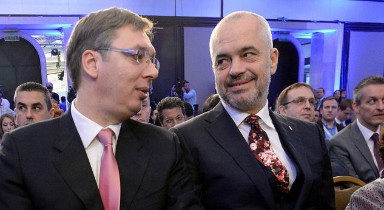
In this context, the leadership style of the Prime Minister of Albania, Edi Rama, has been characterized by a high degree of personalization and political protagonism. This style is manifested through direct communication, the building of personal relationships with regional leaders, and a tendency to actively influence political developments beyond state borders.
One of the most controversial dimensions of this approach is the continuous rapprochement with Belgrade and cooperation with the President of Serbia, Aleksandar Vučić. While in official discourse this is presented as an effort for regional stability and economic cooperation, in practice this approach has produced a number of political and perceptual implications, especially in relation to Kosovo.
From an analytical perspective, this rapprochement has been interpreted as a shift from a traditional policy of support for Kosovo toward a more balanced positioning between Pristina and Belgrade. However, in a context where relations between Kosovo and Serbia remain unresolved and tense, any form of “balancing” is easily perceived as political asymmetry. As a result, an increase in mistrust between the institutions of Albania and Kosovo has been observed, as well as a weakening of inter-Albanian strategic coordination.
At the field level, these developments have reflected concrete consequences, especially in the most sensitive areas of Kosovo. Political discourse and diplomatic signals originating from Albania–Serbia relations directly affect the perception of security, legitimacy, and political support among local communities. In this way, the foreign policy of a state does not remain only at the declarative level but produces tangible effects in socio-political reality.
Furthermore, the personalization of diplomacy brings the risk of strategic ambiguity, as policies become dependent on individual initiatives rather than a stable institutional framework. In a region characterized by historical sensitivity and ongoing rivalries, the lack of such consistency may create space for misinterpretation and new tensions.
In this theoretical and political context, Edi Rama’s interventions in Kosovo can be understood as part of a broader model of political action, which combines personalized leadership with regional initiatives and direct interventions in internal dynamics. The following analysis aims to examine in detail these interventions and their consequences across different dimensions.
The interventions of Edi Rama in Kosovo and the actions of the Prime Minister of Albania, Edi Rama, have shown a model of interference in the internal and external affairs of Kosovo, extending into the fields of culture, politics, diplomacy, economy, and society. His interventions are often presented as cultural cooperation or regional initiatives, but in practice they have influenced in favor of Serbian positions and against the sovereign interests of Kosovo.
This paper aims to honestly analyze all dimensions of Edi Rama’s interventions, including historical and political examples, the impact on Kosovo’s leadership and citizens, and the regional context.
1. Cultural interventions and the rehabilitation of Serbian culture
Edi Rama has used culture as a tool to rehabilitate Serbian figures with anti-Albanian history and to overshadow the cultural contribution of Albanians in Kosovo.
• In 2010, he gave Goran Bregović the key to the city of Tirana, promoting a singer associated with Slobodan Milošević’s ideology¹. This act was perceived as an anti-Kosovo message and a symbolic desecration of the history of Albanian victims.
• In 2016, during his visit to Niš, Rama elevated Ivo Andrić, an ideologue of the extermination of over 40,000 Albanians in Kosovo during World War II, and director Emir Kusturica, creator of films with Serbian fascist ideology².
• At the same time, the main figures of Albanian culture in Kosovo did not receive similar recognition, except for Rexhep Qosja, a co-ideologue of Kosovo’s partition³.
These actions demonstrate a deliberate tendency to rehabilitate Serbian culture in order to normalize the Serbian narrative toward Kosovo.
2. Historical and territorial anti-Albanian projects
Rama has been involved in controversial projects that directly affect Kosovo’s sovereignty and territorial integrity.
• The years 2014–2016 marked Rama’s cooperation with Aleksandar Vučić in the creation of “New Yugoslavia,” a project that aimed to include Kosovo and Albania in a political configuration that undermined Kosovo’s sovereignty⁴.
• He promoted the concept of territorial exchange and discussed this project with former Swedish Foreign Minister Carl Bildt⁵.
• In the framework of these projects, the influence of Ivo Andrić’s ideas for the division of Albanian territories and Serbia’s access to the Adriatic was also documented⁶.
These territorial projects aimed at weakening the Kosovo state and consolidating Serbian influence in the region.
3. Fragmentation of Kosovo politics and impact on leadership
Rama’s political interventions have directly affected the stability of Kosovo’s institutions:
• He contributed to the division between Prime Minister Albin Kurti and President Vjosa Osmani, destabilizing cooperation between leaders⁷.
• At the Peja conference in 2018, Rama publicly insulted the then Prime Minister of Kosovo, Ramush Haradinaj, calling him “donkey,” due to his criticism of efforts to partition Kosovo⁸.
• Rama has repeatedly threatened Albin Kurti at Open Balkan summits (Tirana, Belgrade, Ohrid, Skopje) for refusing the Serbian regional control project⁹.
• He has promoted individuals dismissed from Kosovo institutions, placing them in key positions in Albania to influence Kosovo politics¹⁰.
These interventions have caused political and social fragmentation within Kosovo.
4. Socio-economic and state discrimination
Rama’s policies have included:
• Denial of Albanian citizenship to Kosovo citizens, while favoring citizens from other regions¹¹.
• Obstacles for Kosovo investors in Albania, creating a socio-economic gap that divides Albanian communities¹².
• A tendency to create north–south divisions among Albanians, emphasizing regional and social differences¹³.
• These divisions also extend between Albanians from the north and south, strengthening internal national divides¹⁴.
5. Deception and propagandistic rhetoric
• Rama uses public pro-Kosovo statements such as “Albania and Kosovo will be defended together,” but his actions show an orientation against Kosovo’s sovereignty¹⁵.
• Projects such as the Durrës–Prishtina railway are used as propaganda, without tangible implementation for Kosovo¹⁶.
This shows a strategy of using pro-Kosovo rhetoric as a cover for actions that serve Serbia and the division of Albanians.
6. Impact on regional and international relations
• Rama has rehabilitated and defended Aleksandar Vučić in international summits, presenting him as a peace partner, despite Serbia’s crimes during the Yugoslav wars¹⁷.
• He has hindered Kosovo’s international recognitions through diplomatic lobbying¹⁸.
• His efforts have negatively affected Kosovo’s EU integration perspective and have favored Serbian interests in the Balkans.
Rama’s interventions are multidimensional and interconnected: culture, politics, diplomacy, economy, and society. The rehabilitation of Serbian figures, international lobbying, division of Kosovo’s leaders, discrimination against citizens and investors, north–south division, and propagandistic deception show a consistent strategy against Kosovo’s sovereignty. His actions represent a systematic and comprehensive interference that has undermined Albanian unity and Kosovo’s stability.
7. Conclusion
Nothing personal against Edi Rama, but it was an urgent need for a Strategic Advisory on Regional Policy and Kosovo.
The deconstruction of the interventions of the Prime Minister of Albania, Edi Rama, in Kosovo reveals a model of personalized political action, where individual protagonism and egocentrism directly influence inter-Albanian and regional relations. The continuous rapprochement with Belgrade, often justified as an effort for regional stability and cooperation, has produced a series of sensitive and concrete implications on the ground, including in politics, culture, diplomacy, economy, and society.
1. Weakening of inter-Albanian coordination
Rama’s actions have created persistent discrepancies between Tirana and Pristina. This loss of consensus has been particularly evident in dialogue with Serbia, Open Balkan summits, and regional economic and political integration initiatives. The direct consequences are Kosovo’s political fragmentation, increased institutional mistrust, and a weakened perception of Albania’s support among Kosovo citizens and leaders.
2. Cultural and historical impact
Rama’s cultural policies have favored the rehabilitation of Serbian figures with histories against Albanians, including Goran Bregović, Ivo Andrić, and Emir Kusturica. At the same time, major Albanian figures in Kosovo have not received similar recognition. This creates an unstable historical narrative that relativizes Albanian victims and contributions, and may serve to justify Serbian influence in the region.
3. Territorial projects and controversial policies
Discussions on “territorial exchange” and projects such as “New Yugoslavia” have increased insecurity and tensions in Kosovo. Beyond their direct impact on sovereignty, these projects have favored Serbian interests and undermined the authority of Kosovo institutions, sending messages that can be misinterpreted by local communities and international partners.
4. Impact on Kosovo leadership and political fragmentation
Rama’s interventions in Kosovo’s internal politics have included public insults toward prime ministers, promotion of dismissed individuals in key positions, and direct interference in relations between leaders. This has caused divisions between the prime minister and the president, weakened institutional cooperation, and created a low perception of inter-Albanian unity.
5. Socio-economic discrimination and social polarization
Discriminatory policies toward Kosovo citizens, including denial of citizenship and barriers for Kosovo investors, have created a socio-economic gap and emphasized regional and social divisions. These divisions also extend between Albanians in the north and south, weakening national unity and encouraging artificial divisions.
6. Propagandistic deception and use of rhetoric
Public pro-Kosovo statements, such as those on economic cooperation and infrastructure projects (e.g., the Durrës–Prishtina railway), are often used to justify actions that in practice favor Serbia. This gap between rhetoric and real actions reduces trust in Albanian politics and causes public skepticism regarding strategic intentions.
7. Impact on regional and international relations
The rapprochement with Belgrade and the defense of Aleksandar Vučić in international forums has negatively affected new recognitions of Kosovo, European integration, and Albania’s perception as a reliable regional partner. These actions have favored Serbian interests, reducing Albania’s role as a supporter of Kosovo and regional stability.
Strategic advice for the future
To avoid similar consequences and strengthen Albania’s position and Albanian unity, it is essential that regional policy shifts from a personalized approach to an institutional, transparent, and strategic one:
1.Strong coordination with Kosovo – every diplomatic initiative must reflect consensus and national interests, protecting political unity and inter-Albanian credibility.
2.Respect for history and cultural sensitivities – avoiding the glorification of figures with negative historical impact is essential for maintaining national respect and unity.
3.Transparency and clear communication – publishing the objectives, methods, and outcomes of regional projects will prevent misinterpretations and strengthen public and institutional trust.
4.Pragmatic balance, not personal protagonism – politics must serve regional stability, unity, and prosperity, not individual advantage.
5.Assessment of real impact – every decision must be measured by its actual effect on citizens, the economy, and institutions, not only diplomatic success.
6.Consolidation of regional strategy – every initiative with neighbors must analyze concrete consequences for Kosovo and Albania, based on data analysis, diplomatic expertise, and inter-institutional consultation.
The implementation of these principles will strengthen Albania’s international credibility, consolidate relations with Kosovo, and ensure that regional policy is built on consensus, long-term strategy, and transparency, minimizing tensions and uncertainty.
Only such an approach can guarantee stability, development, and respect for Albanian identity and sovereignty in the region.
Footnotes:
1.N1 Info, “Edi Rama condemned the ‘medieval hysteria’ toward Goran Bregović,” August 23, 2011. The article reports that the Prime Minister of Albania gave the key to the city of Tirana to singer Goran Bregović, an act perceived as elevating Serbian culture and constituting a symbolic disrespect toward Albanian victims of Kosovo.
2.Telegrafi.com, “Rama elevates Ivo Andrić and Kusturica in Niš,” 2016. This report documents Rama’s visit to Niš, where two Serbian figures with ideological and cultural influence against Albanians in Kosovo were honored: writer Ivo Andrić and director Emir Kusturica, both associated with Serbian nationalist ideology and fascist-era propaganda during Milošević’s time.
3.Albanian Historical Science, vol. 12, “The role of Rexhep Qosja and Albanian culture,” 2017. The book analyzes the role of Rexhep Qosja as a co-ideologue with Edi Rama in promoting a narrative that favors the partition of Kosovo and minimizes the contribution of other Albanian cultural figures.
4.Balkan Insight, “Aleksandar Vučić and the project of New Yugoslavia,” 2015. The article describes cooperation between Edi Rama and Vučić in creating a regional project called “New Yugoslavia,” which aimed to include Kosovo and Albania in a configuration that would weaken Kosovo’s sovereignty.
5.Financial Times, Carl Bildt, “Territorial exchange as a solution for Kosovo,” 2016. The former Swedish Foreign Minister acknowledged discussions on the territorial exchange project with Edi Rama, confirming Rama’s efforts to promote a narrative of Kosovo’s partition in favor of Serbia.
6.Albanian Historical Archives, Territorial Projects File 1990–2010. Documents the planning and projects for the division of Albanian territories by Serbian ideologue Ivo Andrić and the later influence of Rama in promoting these territorial concepts.
7.Telegrafi.com, “Rama–Haradinaj incident in Peja,” 2018. The report describes the well-known incident in which Rama insulted the then Prime Minister of Kosovo, Ramush Haradinaj, during a press conference, using derogatory language and demonstrating his influence in destabilizing Kosovo’s leadership.
8.Ibid. It also explains the challenge Rama posed to President Vjosa Osmani and the policies of the Government of Kosovo, showing the division of political institutions.
9.Balkan Insight, “Open Balkan policies and pressure on Albin Kurti,” 2019. It analyzes Rama’s threats toward Kosovo’s Prime Minister Albin Kurti at Open Balkan summits (Tirana, Belgrade, Ohrid, Skopje), where Rama attempted to impose the Serbian regional control project.
10.Gazeta Express, “Rama promotes dismissed Kosovo individuals to key positions in Albania,” 2020. The report shows how Rama has appointed individuals dismissed from Kosovo institutions to key positions in Albania in order to influence Kosovo politics and destabilize its government.
11.Gazeta Shqiptare, “Denial of Albanian citizenship to Kosovo citizens,” 2020. The article documents discrimination against Kosovo citizens in the granting of Albanian citizenship, favoring citizens from other regions.
12.Balkan Insight, “Barriers for Kosovo investors in Albania,” 2019. It analyzes legal and economic challenges and barriers for Kosovo investors in Albania, showing a discriminatory policy that hinders the economic development of Albanians from Kosovo.
13.Radio Free Europe, “North–south division tendencies among Albanians,” 2020. The report examines attempts to divide Albanian citizens between the northwest and the south as a result of Rama’s policies and regional influences.
14.Ibid. The division also extends to relations between Albanians from the north and south of the country, highlighting the impact of Rama’s policies on the social and political fragmentation of Albanians.
15.Radio Free Europe, “Rama: Pro-Kosovo rhetoric and political reality,” 2021. It analyzes the discrepancy between Rama’s public pro-Kosovo statements and concrete actions against Kosovo’s sovereign interests.
16.N1 Info, “Durrës–Prishtina railway: propaganda and reality,” 2019. It shows that the railway project is mainly used as propaganda, without tangible implementation for Kosovo’s citizens and economy.
17.Balkan Insight, “Rama and Vučić: international rehabilitation of Serbia,” 2021. It analyzes Rama’s role in defending Aleksandar Vučić in international forums and efforts to rehabilitate Serbia’s image despite its history in the Yugoslav wars.
18.Ibid. It describes how Rama has influenced international politics to hinder new recognitions of Kosovo and favor Serbian interests.
The Land of Leka;30.03.2026








Discussion about this post